

The debate surrounding home batteries is currently a hot topic due to the impending changes in the energy market. The net metering scheme is set to be phased out by 2027. Below is a rundown of the facts and myths, based on the current situation. This is followed by a technical overview, after which we outline some potential solutions.
Why Home Batteries?
Consumers looking to purchase a home battery system sometimes have expectations that do not match what is on offer. The range of solutions extends from plug-in batteries to complete UPS (Uninterrupted Power Supply) systems. As a consumer, it is often difficult to form realistic expectations, as you are suddenly confronted with a variety of technical systems, each with its own capabilities, limitations and considerations.
The type of energy contract (fixed, variable or dynamic) also plays a role in the choice of battery system. Only with a dynamic contract is it possible to use the battery for energy trading via an intermediary. This is also explained.
Why a home battery makes sense as an investment?

Increasing self-consumption: Without a battery, you use an average of 30% of your own solar power. With a battery, this rises to 60% to 70%, mainly because your night-time consumption is supplied by the battery rather than the grid.
End of net metering from 2027: When the net metering scheme ends on 1 January 2027, electricity fed back into the grid will have virtually no economic value. Storing it for your own use will then become much more financially attractive.
Trading with dynamic tariffs: With a dynamic energy contract, a smart battery can purchase cheap electricity (e.g. when there is plenty of wind or sunshine) and use it when prices are high. This can speed up the payback period.
Independence and backup: You are less vulnerable to price rises on the grid and, in the event of a power cut, you can – provided you choose the right system – continue to use essential appliances such as your freezer and fridge.

The nonsense about home batteries

It is claimed that a battery is “always cost-effective“. That is not true. In the current market, with net metering, the payback period for batteries is very long, at around 8 years. A battery is often still a “hobby investment” unless you use it to trade on the electricity grid.
With batteries, you could go “completely off-grid“. That’s not true either. In the winter months in the Netherlands, you generate too little energy to keep the battery sufficiently charged. With a fully charged battery, you can go off-grid for a few days at most. When it’s dark and gloomy for a week, you remain dependent on the mains supply.
The claim that batteries “save the environment” is also untrue. Battery production is energy-intensive and requires (scarce) raw materials. However, they do help prevent grid congestion and voltage surges. They ensure that the low cost of solar power helps keep electricity available during peak demand periods.
A 5kWh battery with a capacity of 5kWh is by no means always accurate. Pay close attention to the small print. For virtually all batteries, it’s best not to discharge them below 10% or charge them above 90%. In practice, this leaves you with only 80% = 4kWh of capacity. This can be quite misleading and varies from brand to brand.
“Every kWh that goes into the battery, I get back later” isn’t true either. In reality, it doesn’t get much better than 90%. This is because it takes energy to convert electricity into a chemical battery process. And conversely, it takes energy to convert the stored chemical energy back into electricity. The round-trip efficiency (RTE) of batteries is usually only 70–80%. In particular, a heavy battery pack capable of delivering several kW of power will only need to supply a few hundred watts of night-time power. In that range, the battery inverter operates less efficiently.
Read the following article too:
The technology behind home batteries
A home battery consists of a set of battery cells surrounded by electronics and software designed to control the charging and discharging process effectively and safely.
The first layer is known as the BMS (Battery Management System). The BMS monitors all battery cells and ensures that they are not overcharged or completely discharged. This is an essential technical component of all batteries and is hidden from the end user.
The second layer is the EMS (Energy Management System). End users have partial access to the EMS via configurable parameters or profiles. The default setting is usually to minimise the export of solar power. In other words, solar power is used to power appliances and to charge the battery. Power will only be fed back into the electricity grid once the home battery is fully charged and there is still a surplus of solar power.
The third layer is SEMS (Smart Energy Management System). Software makes it possible to direct energy flows to devices. For example, by only activating the charging point when the sun is shining. Or by trading surplus energy on the energy market. Energy trading is a service offered by a number of specialist energy suppliers. The home battery is then controlled by an external party and can be charged or discharged at any time, depending on the needs of the energy grid. As an end user, you have relinquished control over the home battery.
Technical solutions
Portable plug-in batteries with or without a socket
In most cases, a battery capacity of 60–80% of your daily consumption is sufficient. In many cases, 5–10 kWh is therefore enough. Plug-in batteries are receiving a lot of media attention. They are available for €0.3–0.4/kWh, or €1,500–2,000 for 5 kWh. This is cost-effective and easy to connect to a socket, but it also has technical limitations.
A 5kWh battery system can easily weigh 60–70kg. That is why these plug-in batteries are usually supplied in a wheeled case to make them portable.
You’ll need some DIY skills because a data link needs to be established with the electricity meter. This requires additional components (a P1 meter or CT transformers on the incoming three-phase connection). Installing this hardware quickly becomes a job for a specialist. This involves additional costs. A day’s work by an electrician, plus the cost of the hardware, can easily run to around €1,000.
Some home batteries have an output socket, so you effectively have a power bank with a 230V socket. As soon as the mains power fails, the solar panels stop working, and so does the battery. The whole street is left in the dark, and so are you. However, you do have the option of plugging in a lamp or an appliance.


Home batteries with a fixed connection without UPS
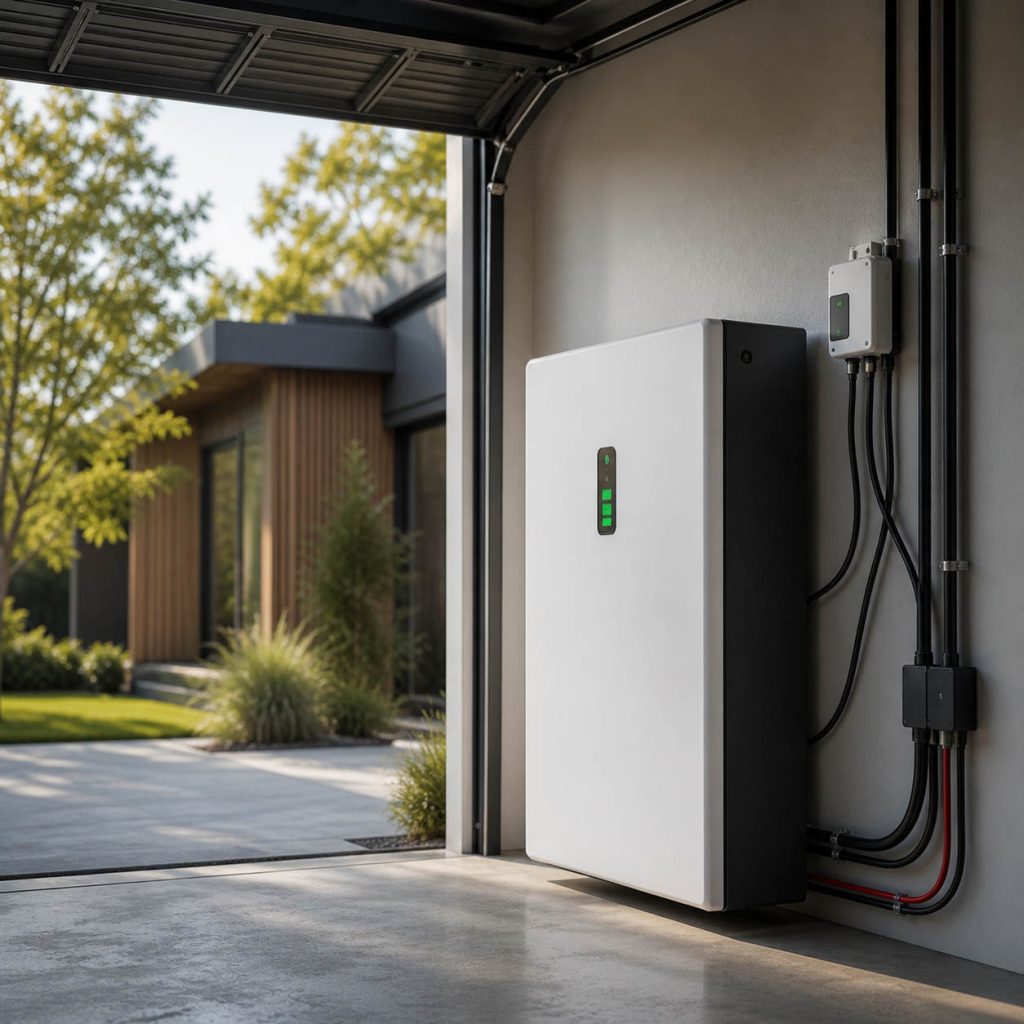
The power at which a portable battery can charge and discharge should be limited to 800W when connected to a mains socket. With a fixed connection to the fuse box, this limit may be three times higher, meaning it can draw or supply up to 2400W. The battery is then no longer portable and is connected directly to a separate circuit in the fuse box.
As soon as the mains power fails, the solar panels stop working, but the battery output can then be connected to essential appliances such as a fridge, a freezer, etc. To do this, you’ll need to run an extension lead to these appliances. If the power cut lasts a long time, it can be a bit of a faff, but it’s accepted because it’s the most cost-effective option. And you’re completely in control.
Fixed home battery with a fixed connection with UPS
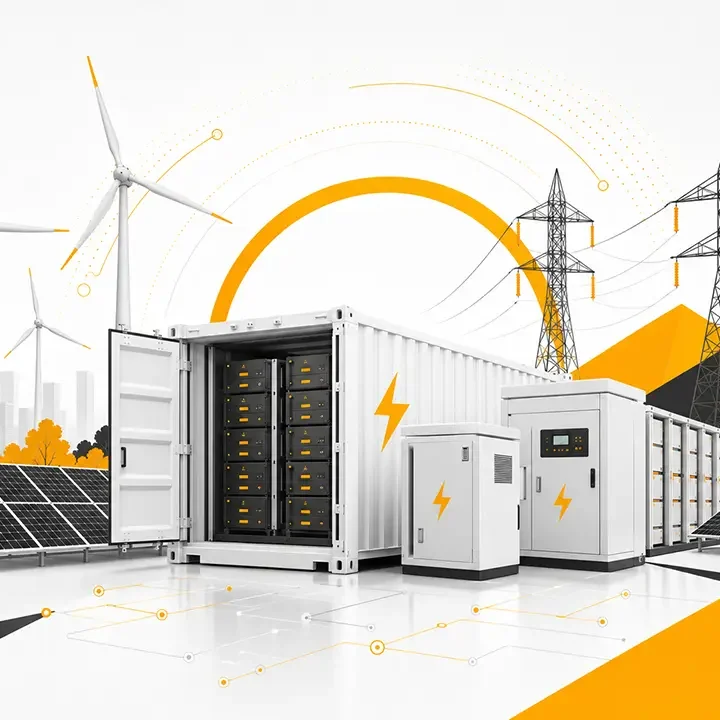
If you want to be independent of the mains supply for a longer period, you will need to install a larger home battery. These are often stackable units, each with a capacity of 5kWh, allowing you to install a total capacity of 50kWh, for example. In that case, you will need to install a permanent system.
Due to the size of the installation, fire compartmentalisation is recommended. Alternatively, it should be installed in a room with a non-combustible background and a separate exhaust system leading to the outside.
It is now also possible to install a permanent emergency power supply. If the mains power fails, the whole street will be in the dark – but not you!
Everything continues to operate as normal via the battery pack’s emergency power supply. This requires modifications to the fuse box. Not all circuits need to be connected to the emergency power supply. High-power circuits such as a charging point, an air conditioning unit or a heat pump are best switched off to prevent the home battery from draining very quickly. Sometimes the modifications are complex because the property was not originally designed for an emergency power supply. It can become particularly complicated if the battery has to be installed in the loft.

Most home battery systems operate independently of the solar power system. So when the grid goes down, the solar power system also stops working. The battery pack switches to emergency power supply. This means that the solar panels can no longer generate electricity during a power cut. However, there are now integrated battery-PV all-in-one systems that solve this problem. GoodWe, Huawei, Growatt and Enphase already offer this, and are increasingly focusing on smart grid home installations by also supplying the charging point and/or heat pump. On the one hand, it is a lock-in; on the other hand, as a consumer, you are dealing with just one brand and one SEMS platform that you can configure yourself.
It’s your own battery system and you’re completely in control.
The energy contract
In the Netherlands, you can choose from three types of energy contract: fixed-rate, variable-rate or dynamic.
With a fixed-term contract, all costs are fixed for the agreed period, usually 1 to 3 years. You know what it costs to purchase a kWh of electricity, and you also know what you’ll get in return when you feed surplus solar power back into the grid. A battery then simply helps to store surplus energy so that it can be used at other times, such as at night. You then no longer have to pay for it. It takes around 8 years to recoup the cost of the home battery.
With a variable-rate energy contract, the monthly rates are fixed. This actually works in the same way as a fixed-rate contract. When combined with solar panels and a battery, this is the least sensible choice because rates are lower in summer than in winter, whereas your solar panels generate the most energy in summer.
With dynamic pricing, the cost of energy varies by the hour (day-ahead market). Sometimes it even varies by the quarter-hour (imbalance market). A smart battery can then purchase cheap electricity – for example, when there is plenty of wind and/or sunshine – and use it when prices are high. This can speed up the payback period.
This immediately limits your choice of battery brands, as the energy supplier must install a small box on the battery pack in order to communicate with it. This automatically means you are no longer fully in control, unless you want to enter the battery’s energy profile yourself every day. The alternative is that the battery can be controlled via an app. This type of control is still in the development phase, which means that the options are limited.
At present, controllable battery systems are only available with a plug-in output, and not with a UPS system connected to them. Only Enphase currently appears to be able to offer this.
Conclusions
The costs and benefits of home batteries depend heavily on individual circumstances.
The simplest solution is a plug-in battery with a plug-in module that reads the P1 port of the electricity meter. If you opt for a model with a 240V socket output, you’ll have emergency power available in the event of a mains power cut. For €2,000, you’ll have 5kWh of storage capacity in your home, allowing you to increase your self-consumption of solar power from 30% to around 60%. After ~8 years, you’ll have recouped the value of the solar power costs you would otherwise have missed out on.
Larger battery systems that continue to supply part of the home during (prolonged) power cuts are considerably more complex and expensive. Firstly, sufficient space is required to install such a system. It is also necessary to engage a professional to carry out the electrical and structural preparations. These costs can quickly run into several thousand euros for meter box modifications and extensions. With this type of system, you can use the battery for energy trading via specialist energy suppliers. For 20kWh of capacity, you would pay €10,000–20,000, with part of the VAT being recoverable. By actively trading on the day-ahead and imbalance markets, it is possible to reduce the payback period to less than 8 years.
Overview

| Plug-in home battery | Fixed connection | UPS-system | |
|---|---|---|---|
| Capacity |
5 kWh typical, as trolley case |
5–10 kWh fixed setup |
10–50 kWh stackable modules |
| Max. power | 800 W | 2400 W | 2400+ W |
| Installation | Outlet + P1/CT coupling — partly DIY, partly by an electrician | Fixed circuit in meter box — electrician required | Meter box + structural modification — specialist required |
| Costs (indication) | € 1.500–3.000 | € 3.000–6.000 | € 10.000–20.000 |
| Mobile | ✔ | ✘ | ✘ |
| Increase self-consumption | ✔ | ✔ | ✔ |
| Emergency power in case of outage | Partially optional 230V output | Partially manual extension cord | Yes, automatic, entire home |
| Critical loads always on | ✘ | ✘ | ✔ |
| Energy trading (SEMS) | Yes via app/dynamic rate | Limited | Yes day-ahead + imbalance market |
| Dynamic contract required | Required for commercial use | Required for commercial use | Required for commercial use |
| Payback period | ~8 years (without commercial use) | ~8 years (without trading) | < 8 years (with trading) |
| Fire compartmentation | Not required | Not required | Recommended |
| In control as a user | Full | Full | Partial (with energy trading) |
| Suitable for | Easy setup, increasing self-consumption | More power, limited backup power | Maximum independence, commercial use |