


Walk through a protected village centre and you’ll notice something: barely a solar panel in sight. Not because the residents don’t want one — but because in many cases, they’re not allowed to. For homeowners of listed buildings or homes within a protected townscape, going solar is rarely as simple as picking a panel and calling an installer.
Why monuments play by different rules
In the Netherlands, placing solar panels on or near a listed monument, or within a protected village or cityscape, almost always requires an environmental permit (omgevingsvergunning). The reasoning is straightforward: municipalities want the energy transition to reach these homes too, but not at the cost of the historic character that made them worth protecting in the first place.
The general principle almost every municipal policy repeats: panels should preferably be placed out of sight — on a rear roof plane, an outbuilding, or a section not visible from public space. Only when that’s genuinely impossible does the conversation shift to what’s allowed on the visible roof itself.
What "allowed" usually means
Even where visible placement is considered, the conditions are strict:
- No damage to historically valuable materials. The original roof tiles typically have to remain intact underneath.
- Reversibility. Any mounting structure must be removable without leaving lasting damage — as if the panels were never there.
- Minimal visual disruption. Careful, restrained placement that doesn't compete with the character of the façade or roofline.
This is where most conventional solar installations run into trouble. A standard panel, even a “full black” one, sits on top of the roof as a distinct object — a rectangle of glass and aluminium bolted onto a structure of centuries-old tiles. However neatly it’s installed, it’s still a visible, irreversible statement.
Where tile-integrated solar changes the equation
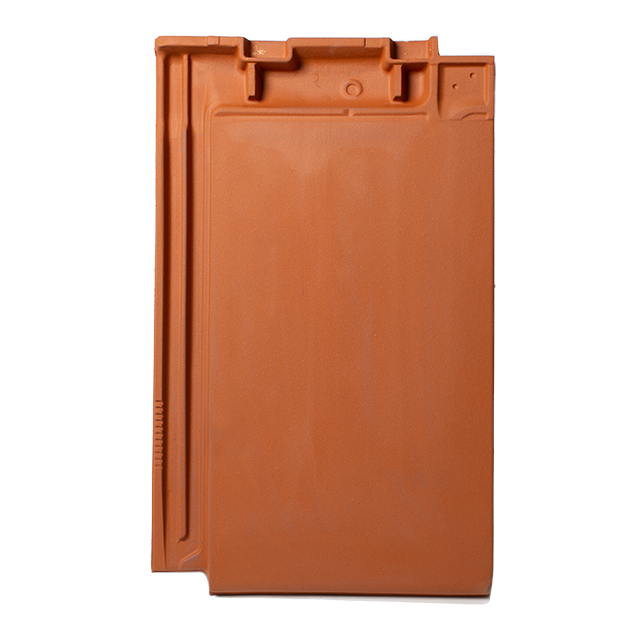
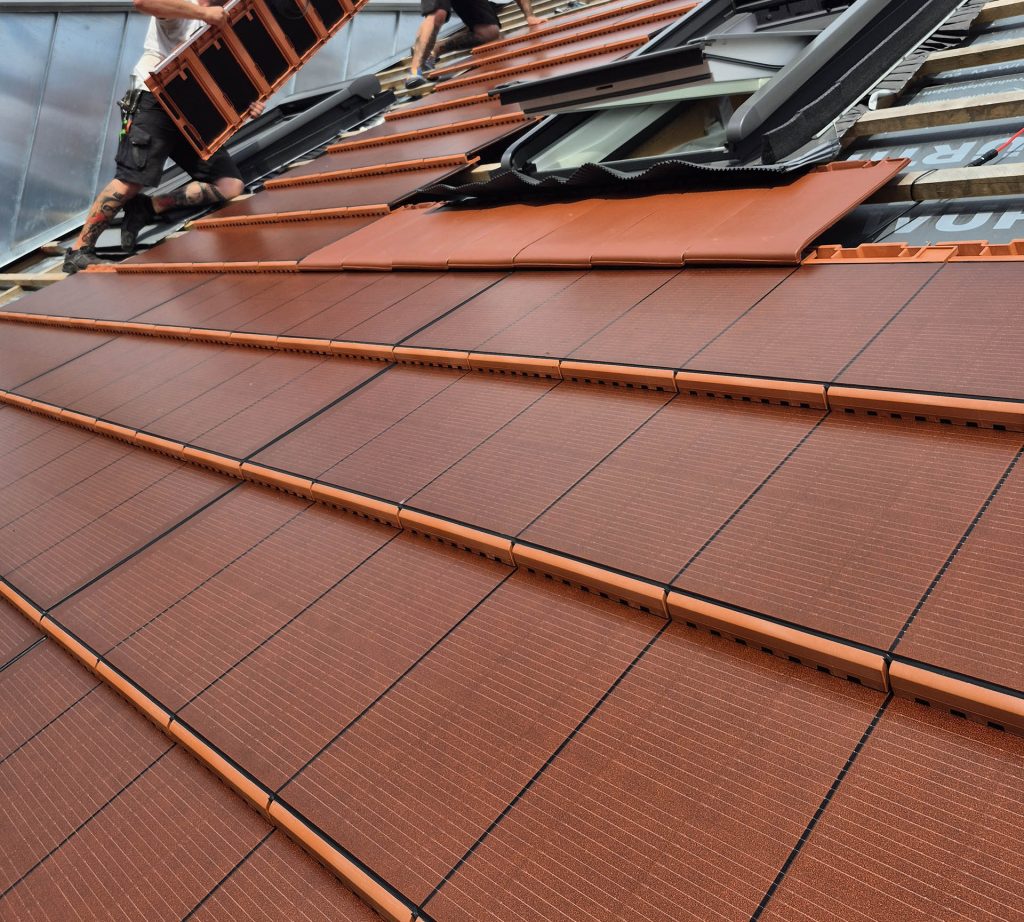
This is precisely the dilemma our solar roof tiles were designed to solve. Because the technology is built into a shape that replaces 3 to 6 roof tiles at once — rather than sitting on top of them — the roof keeps its original silhouette. No frames, no glare, no rectangle breaking up the line of the tiles.
For heritage committees, that distinction matters more than it might seem. Municipal guidelines are increasingly explicit that the impact on the roof’s appearance — not the mere presence of solar technology — is what’s being assessed. A solution that reads as “still a tiled roof” starts a very different conversation than one that reads as “solar panels on a monument.”
It doesn’t remove the need for a permit application, and every case remains its own assessment — heritage advisory committees decide per address, per roof, per visibility from the street. But it does mean homeowners can bring a genuinely different proposal to the table: one where preserving the tile pattern and going solar aren’t presented as a trade-off.
The bigger shift
Since around 2020, national and municipal guidance on solar and heritage has been moving in one direction: from “no, unless” to “yes, if done carefully.” That’s good news for the thousands of monument owners who’ve watched their neighbours install panels while their own roof stayed untouched.
But loosened policy still leaves the hardest part unchanged — the design itself has to actually respect the roof it sits on. That’s not a permit problem. It’s a product problem.